
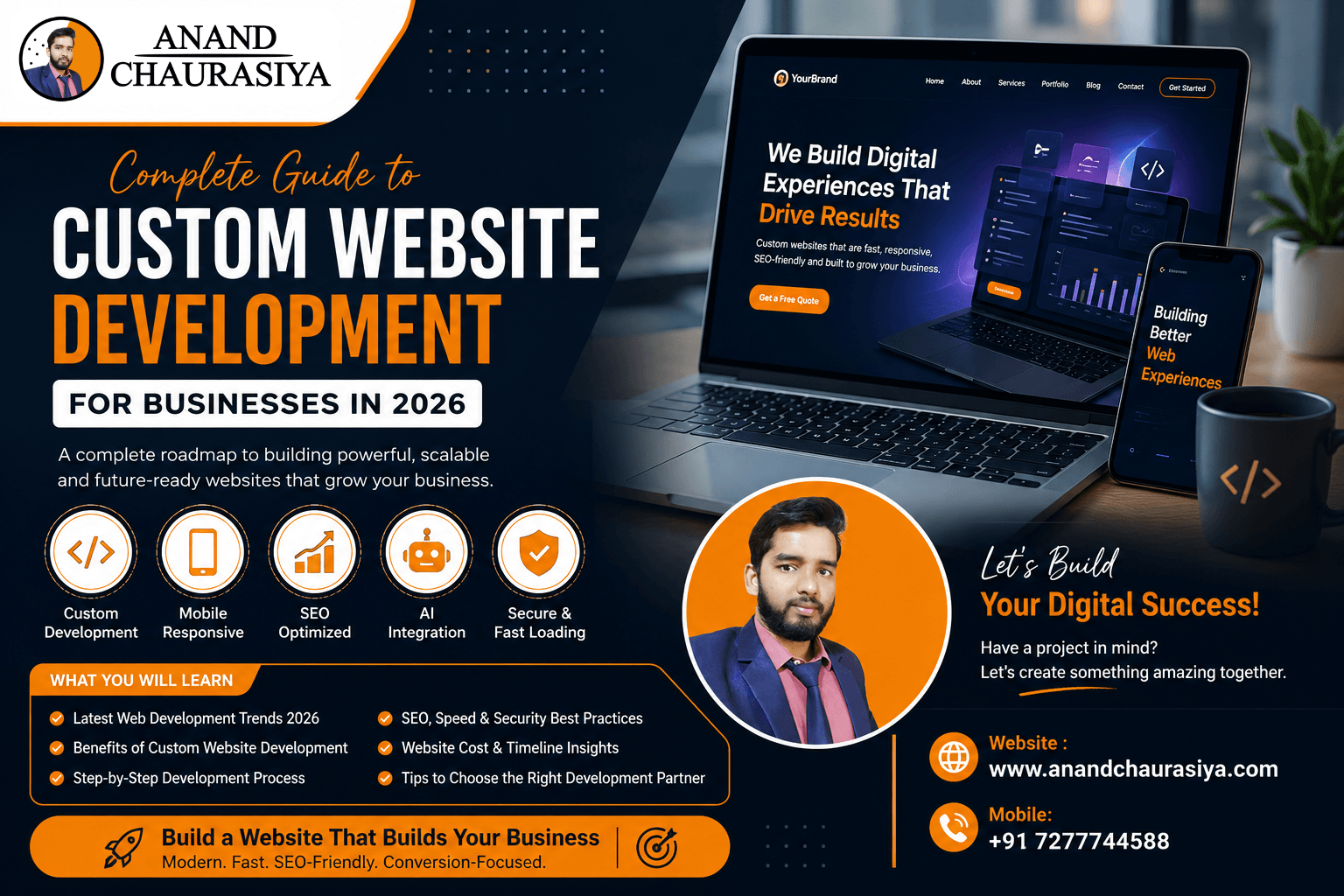
Custom Website Development: Complete Guide for Businesses in 2026
In 2026, having a website is no longer just about putting your business name, phone number, and services online. Your website is often the first impression customers have of your brand—and in many cases, it can be the difference between getting a new customer or losing one to a competitor.
Think about it: A potential customer searches for your business on Google, clicks your website, and expects to find exactly what they need within seconds. If your website is slow, confusing, outdated, or difficult to use, they may simply click the back button and choose someone else.
That's where custom website development comes in.
Unlike ready-made templates that offer the same structure to thousands of businesses, a custom website is designed and developed around your specific goals, audience, branding, and business requirements.
In this complete guide, we'll explore custom website development in 2026, the latest trends businesses should know, its benefits, development costs, SEO considerations, and how to choose the right approach for your business.
Let's get started.
What Is Custom Website Development?
Custom website development means creating a website specifically for a business or organization based on its unique requirements.
Instead of simply installing a pre-designed theme and changing the colors and text, developers build the website's design, functionality, and backend structure around the business.
A custom website may include:
-
Custom UI/UX design
-
Custom frontend development
-
Custom backend development
-
Database integration
-
Customer login systems
-
Booking and appointment systems
-
Payment gateway integration
-
CRM integration
-
Admin dashboards
-
API integrations
-
AI chatbot integration
-
Automated workflows
-
Advanced SEO features
-
Custom business tools
For example, imagine you run a service business in Bangalore. You may need a website where customers can search for services, submit enquiries, book appointments, receive WhatsApp notifications, and track their requests.
A basic template may not support all these requirements properly. A custom website development solution can be built specifically around your business workflow.
Practical Takeaway
Before starting development, write down the top 5 things you want customers to do on your website. These could be:
-
Call your business
-
Submit an enquiry
-
Book an appointment
-
Purchase a product
-
Request a quote
Your website should make these actions simple and obvious.
Why Is Custom Website Development Important in 2026?
The online world has become extremely competitive.
Almost every industry now has multiple businesses competing for the same customers. Whether you're a startup, local business, service provider, eCommerce brand, or professional, your website needs to do more than simply "exist."
A modern website should:
-
Load quickly
-
Work perfectly on mobile
-
Be easy to navigate
-
Build trust
-
Rank well on Google
-
Generate leads
-
Support marketing campaigns
-
Integrate with business tools
-
Provide a smooth customer experience
This is why businesses are increasingly investing in custom web development services.
A professionally developed website can become a long-term digital asset that supports your marketing, sales, branding, and customer service.
Custom Website vs Template Website: What's the Difference?
One of the biggest questions business owners ask is whether they should choose a custom website or a template-based website.
Here's a simple comparison:
| Feature | Custom Website | Template Website |
|---|---|---|
| Design | Unique | Pre-designed |
| Flexibility | Very High | Limited |
| Scalability | Excellent | Depends on platform |
| Performance | Optimizable | Varies |
| SEO Control | Advanced | Usually Limited |
| Features | Fully Customizable | Predefined |
| Security | Customizable | Depends on platform/plugins |
| Cost | Higher Initial Investment | Lower Initial Cost |
| Long-Term Control | High | Platform Dependent |
A template website may be perfectly suitable for a small business with basic requirements.
However, if you want a unique digital experience, advanced functionality, better scalability, or complete control over your website, custom website development may be the better choice.
Practical Example
A restaurant may only need a simple website with a menu, location, and contact details.
But a food delivery business may require:
-
User accounts
-
Restaurant listings
-
Online ordering
-
Payment processing
-
Delivery tracking
-
Admin management
-
Notifications
The second business would benefit significantly from a custom-built solution.
Top Custom Website Development Trends for 2026
Technology and customer expectations are changing quickly. Let's look at some of the most important web development trends in 2026.
1. AI-Powered Websites Are Becoming Mainstream
Artificial intelligence is no longer limited to experimental projects.
Businesses are increasingly using AI to improve customer experiences and automate repetitive tasks.
Modern websites can use AI for:
-
Customer support chatbots
-
AI-powered search
-
Personalized recommendations
-
Lead qualification
-
Automated responses
-
Content assistance
-
Voice-based interactions
For example, a website visitor could ask:
"Which website development package is best for my small business?"
An AI assistant could understand the question and recommend the right service.
Practical Takeaway
If your business receives repetitive customer questions, consider integrating an AI chatbot into your website. It can help visitors find answers faster while reducing the workload on your team.
2. Mobile-First Website Development
Your customers are probably browsing your website from smartphones.
That's why mobile-first web development is one of the most important priorities in 2026.
A mobile-first website focuses on creating an excellent experience for smaller screens before expanding the design for desktops.
A good mobile website should have:
-
Easy-to-read text
-
Large touch-friendly buttons
-
Simple navigation
-
Fast loading
-
Responsive layouts
-
Easy-to-use forms
Practical Takeaway
Open your website on your own smartphone and try to complete your main goal—such as contacting the business or requesting a quote.
If it takes more than a few seconds to figure out what to do, your mobile UX probably needs improvement.
3. Speed and Core Web Vitals Matter More Than Ever
Nobody likes a slow website.
If a page takes too long to load, visitors may leave before seeing your content.
Website speed also affects the overall user experience and can influence your search visibility.
Modern custom websites should focus on:
-
Optimized images
-
Clean code
-
Efficient CSS and JavaScript
-
Fast hosting
-
Browser caching
-
Lazy loading
-
CDN usage
-
Reduced third-party scripts
Practical Takeaway
Compress large images before uploading them. A beautiful website isn't useful if visitors are waiting forever for it to load.
4. Personalization Is Improving Customer Experience
In 2026, websites are becoming more personalized.
Instead of showing exactly the same experience to every visitor, businesses can use data and technology to create more relevant experiences.
For example:
A returning customer might see personalized recommendations.
A visitor from Bangalore might see local service information.
A business customer might see a dedicated dashboard.
Personalization can make websites feel more useful and relevant.
Practical Takeaway
Start small. You don't need advanced AI personalization immediately. Even showing location-specific content or returning-user recommendations can improve engagement.
5. Voice Search and Conversational Interfaces
People are becoming more comfortable using voice assistants and conversational search.
This means businesses should think about how their customers naturally ask questions.
For example, instead of searching:
"Website developer Bangalore"
Someone might ask:
"Who provides custom website development services near me?"
This creates opportunities for businesses to optimize their content around natural-language queries.
Practical Takeaway
Create FAQ sections that answer real customer questions in a conversational format.
Instead of:
"Services"
Try:
"How much does custom website development cost?"
"How long does it take to build a website?"
"Can you integrate a payment gateway?"
6. Security Is a Business Priority
Cybersecurity is becoming increasingly important as websites collect more customer data.
A professional website should take security seriously from day one.
Important security practices include:
-
HTTPS/SSL
-
Secure authentication
-
Strong password policies
-
Regular updates
-
Data validation
-
Secure API integrations
-
Regular backups
-
Access control
For websites handling payments or sensitive customer information, security becomes even more important.
Practical Takeaway
Don't wait until your website gets hacked to think about security. Build security into the development process from the beginning.
7. Headless and API-First Development
Headless architecture separates the frontend experience from the backend system.
This gives businesses more flexibility to deliver content across different platforms.
For example, the same backend content could potentially power:
-
A website
-
A mobile app
-
A customer portal
-
A digital kiosk
API-first development also makes it easier to connect different systems.
Practical Takeaway
If your business plans to expand into mobile apps or multiple digital platforms, discuss API-first architecture with your development team before starting the project.
8. Progressive Web Apps Are Gaining Attention
Progressive Web Apps, commonly called PWAs, combine some advantages of websites and mobile applications.
Depending on the implementation, users can enjoy features such as:
-
Fast performance
-
Offline capabilities
-
App-like experiences
-
Push notifications
-
Home-screen installation
PWAs can be useful for businesses that want a strong mobile experience without immediately building separate native apps.
Practical Takeaway
If most of your customers use mobile devices and your business needs app-like functionality, ask your developer whether a PWA could be a practical solution.
9. Accessibility Is No Longer Optional
A good website should be usable by as many people as possible.
Accessibility-focused development considers users who may have visual, hearing, motor, or cognitive disabilities.
Important practices include:
-
Proper heading structure
-
Keyboard navigation
-
Alternative text for images
-
Good color contrast
-
Descriptive buttons
-
Accessible forms
Accessibility can also improve usability for everyone.
Practical Takeaway
Don't use buttons that simply say "Click Here" when you can clearly describe the action, such as "Request a Free Quote."
10. SEO Is Being Built Into Development
SEO shouldn't be something you think about after launching your website.
In 2026, developers and marketers need to work together from the beginning.
A custom website should consider:
-
SEO-friendly URLs
-
Meta titles
-
Meta descriptions
-
Heading structure
-
Schema markup
-
XML sitemap
-
Robots.txt
-
Canonical tags
-
Internal linking
-
Image optimization
-
Page speed
-
Mobile responsiveness
Technical SEO creates a strong foundation for future content marketing.
Practical Takeaway
Before launching your website, create a checklist for technical SEO. Fixing SEO problems before launch is usually easier than rebuilding the structure later.
Benefits of Custom Website Development for Businesses
So, why should a business invest in custom web development?
Here are some of the biggest benefits.
1. Unique Brand Identity
Your website can look and feel completely different from your competitors.
Your colors, typography, animations, layouts, and user experience can reflect your brand.
2. Better Scalability
As your business grows, your website can grow with it.
You can add:
-
New features
-
Customer accounts
-
Payment systems
-
CRM integrations
-
AI tools
-
Advanced dashboards
3. Better Performance
Custom development allows developers to focus on optimizing the website specifically for your requirements.
This can reduce unnecessary code and improve performance.
4. Improved User Experience
Every part of the website can be designed around your customers.
The goal is simple:
Help visitors find what they need quickly.
5. Better SEO Control
A custom-built website can give developers greater control over technical SEO elements.
This is especially useful for businesses targeting competitive keywords and local search results.
6. More Business Automation
Your website can connect with your existing business systems.
For example:
Website enquiry → CRM → Sales team notification → WhatsApp follow-up → Email confirmation
That's more than a website.
That's a digital business system.
How Much Does Custom Website Development Cost in 2026?
The cost of a custom website depends heavily on the project's complexity.
A simple custom business website may cost less than a complex web application.
The final cost can depend on:
-
Number of pages
-
UI/UX design
-
Custom functionality
-
Backend development
-
Database requirements
-
Payment gateway
-
API integrations
-
AI integration
-
CRM integration
-
Admin panel
-
Security requirements
-
SEO requirements
-
Maintenance
For example:
Basic Custom Business Website
Suitable for:
-
Small businesses
-
Consultants
-
Local service providers
Advanced Business Website
Suitable for:
-
Growing companies
-
Lead generation businesses
-
Multi-location businesses
Custom Web Application
Suitable for:
-
Marketplaces
-
SaaS platforms
-
Booking systems
-
Business management platforms
Instead of choosing a developer based only on the lowest price, consider the long-term value.
A cheap website that doesn't generate leads may cost more than a professional website that consistently brings customers.
How Long Does It Take to Build a Custom Website?
The timeline depends on the project's complexity.
A simple business website might take a few weeks.
A larger custom web application may take several months.
A typical process includes:
-
Business requirement analysis
-
Competitor research
-
Sitemap planning
-
UI/UX design
-
Frontend development
-
Backend development
-
Database integration
-
API integration
-
SEO implementation
-
Testing
-
Security checks
-
Launch
Practical Takeaway
Don't rush the planning stage.
A few extra days spent properly defining requirements can save weeks of development changes later.
How to Choose the Right Custom Website Development Company
Choosing the right development partner is extremely important.
Before hiring a developer or agency, check:
-
Previous projects
-
Portfolio quality
-
Technical expertise
-
Communication
-
SEO knowledge
-
Mobile development experience
-
Security practices
-
Maintenance support
-
Client reviews
Ask questions like:
Will I own my website and source code?
Can I add new features later?
Is SEO included in development?
Will the website be mobile-friendly?
What happens after launch?
Do you provide maintenance and security updates?
These questions can help you avoid problems later.
A Simple Custom Website Development Process
Here's a simplified process that businesses can follow.
Step 1: Define Your Goals
What do you want the website to achieve?
More leads?
More sales?
Online bookings?
Brand awareness?
Step 2: Understand Your Audience
Identify who your ideal customers are and what problems they want to solve.
Step 3: Plan Your Website Structure
Create a sitemap with important pages such as:
-
Home
-
About
-
Services
-
Products
-
Portfolio
-
Blog
-
Contact
Step 4: Design the User Experience
Create wireframes and UI designs before coding.
Step 5: Develop the Website
The development team builds the frontend, backend, database, and integrations.
Step 6: Add SEO
Implement technical SEO and optimize important pages.
Step 7: Test Everything
Test:
-
Mobile devices
-
Desktop browsers
-
Forms
-
Links
-
Speed
-
Security
-
Functionality
Step 8: Launch and Monitor
After launch, monitor:
-
Traffic
-
Leads
-
Conversions
-
Search rankings
-
User behavior
A website isn't "finished" on launch day. It should continue improving based on real user data.
Common Mistakes Businesses Make
Many businesses make avoidable mistakes when building their websites.
Mistake 1: Focusing Only on Design
A beautiful website that doesn't generate leads isn't necessarily a successful website.
Mistake 2: Ignoring Mobile Users
Most customers expect a smooth mobile experience.
Mistake 3: Forgetting SEO
If Google can't properly understand your website, ranking can become difficult.
Mistake 4: Using Too Many Plugins or Scripts
Extra tools can slow down your website and create security risks.
Mistake 5: No Clear Call-to-Action
Visitors should know what to do next.
Examples:
-
Get a Quote
-
Book a Consultation
-
Call Now
-
Request a Demo
-
Start Your Project
Mistake 6: No Maintenance Plan
Websites need ongoing updates, monitoring, backups, and security checks.
The Future of Custom Website Development
The future of websites is moving toward more intelligent, personalized, and automated experiences.
We can expect businesses to increasingly adopt:
-
AI-powered customer support
-
Voice interfaces
-
Advanced personalization
-
Automated lead qualification
-
AI-driven analytics
-
Smarter search
-
Real-time business dashboards
-
No-code and low-code integrations
-
API-driven ecosystems
However, technology alone won't make a website successful.
The most successful websites will combine technology with something even more important:
A clear understanding of the customer.
If your website solves real customer problems, loads quickly, looks professional, and makes it easy to take action, you're already ahead of many competitors.
Final Thoughts: Is Custom Website Development Worth It in 2026?
Absolutely—if you choose the right approach.
A website should not be treated as just another business expense. When developed strategically, it can become one of your most valuable digital assets.
A well-planned custom website development project can help your business:
-
Build credibility
-
Improve online visibility
-
Generate leads
-
Increase conversions
-
Automate repetitive tasks
-
Deliver better customer experiences
-
Scale as your business grows
The key is to start with your business goals rather than technology.
Ask yourself:
What do I want my website to achieve?
Once you know the answer, you can choose the right technology, features, design, and development strategy.
Whether you're launching a startup, growing a local business, or building a large digital platform, 2026 is a great time to invest in a website that is designed specifically for your customers and your business.
Have you recently built a custom website for your business? What feature has made the biggest difference for you? Share your experience in the comments and don't forget to share this guide with another business owner or marketer who is planning a new website in 2026.
Frequently Asked Questions (FAQs)
1. What is custom website development?
Custom website development is the process of designing and developing a website specifically according to a business's unique requirements, branding, functionality, and goals.
2. Is custom website development better than WordPress?
It depends on your requirements. WordPress can be excellent for many businesses, while custom development may be more suitable for businesses that need unique functionality, advanced integrations, or complete control over their website.
3. How much does a custom website cost in 2026?
The cost varies depending on the design, number of pages, features, integrations, and technical complexity. A simple business website will generally cost significantly less than a custom web application or marketplace.
4. How long does custom website development take?
A simple website may take a few weeks, while complex platforms can take several months. The timeline depends on project requirements and the development process.
5. Is custom website development good for SEO?
Yes. A properly developed custom website can provide strong technical SEO foundations, including clean URLs, optimized page structures, fast performance, mobile responsiveness, schema markup, and better control over technical SEO.
6. Can I add AI to my custom website?
Yes. Businesses can integrate AI chatbots, AI-powered search, recommendation systems, automated lead qualification, and other AI-powered features into custom websites.
7. Should small businesses invest in custom website development?
It depends on the business goals and budget. Small businesses with basic requirements may be comfortable with simpler solutions, while businesses that need advanced features or long-term scalability may benefit from custom development.
8. Is website maintenance necessary after development?
Yes. Regular maintenance helps keep websites secure, updated, fast, and functional. Businesses should consider ongoing backups, security monitoring, performance optimization, and technical updates.
9. What is the biggest benefit of custom website development?
The biggest advantage is flexibility. Your website can be designed and developed around your specific business requirements instead of forcing your business to fit into a pre-built template.
10. How do I choose a custom website development company?
Review the company's portfolio, technical expertise, communication process, client feedback, SEO knowledge, security practices, and post-launch support before making a decision.
Comments (0)
No comments yet. Be the first to share your thoughts!